Free UK delivery
First pouch £19 when you subscribe
Third-Pary tested
Vegan Friendly
No artificial colours
Free UK delivery
First pouch £19 when you subscribe
Third-Pary tested
Vegan Friendly
No artificial colours
Journal updates
Once a month we both write something. We're not the best writers, but it's always relevant to health and wellbeing, We promise it's worth subscribing.
Follow our socials:
" height="47.8243px" id="hNm8SnHsN" width="48.001px"/><path d="M 20.148 22.45 L 21.494 15.115 L 13.655 15.115 L 13.655 12.521 C 13.655 8.646 15.176 7.155 19.111 7.155 C 20.333 7.155 21.317 7.185 21.883 7.244 L 21.883 0.596 C 20.81 0.298 18.186 0 16.666 0 C 8.646 0 4.949 3.786 4.949 11.955 L 4.949 15.115 L 0 15.115 L 0 22.45 L 4.949 22.45 L 4.949 38.409 C 6.805 38.869 8.747 39.115 10.746 39.115 C 11.73 39.115 12.701 39.055 13.654 38.94 L 13.654 22.45 L 20.147 22.45 Z" fill="rgb(255, 255, 255)" height="39.11523px" id="IZwduF6H0" transform="translate(13.253 8.885)" width="21.883200000000002px"/></g></svg>)
" height="46.08008018188477px" id="PmDeKs1T2" transform="translate(9.439 1.92)" width="35.86505px"/><path d="M 26.753 13.487 C 29.841 15.701 33.622 17.004 37.705 17.004 L 37.705 10.796 C 35.426 10.308 33.408 9.113 31.89 7.45 C 29.293 5.824 27.422 3.14 26.873 0 L 21.148 0 L 21.148 31.501 C 21.135 35.174 18.166 38.147 14.503 38.147 C 12.345 38.147 10.428 37.115 9.214 35.516 C 7.046 34.417 5.559 32.163 5.559 29.559 C 5.559 25.876 8.533 22.89 12.203 22.89 C 12.907 22.89 13.584 23 14.22 23.203 L 14.22 16.927 C 6.339 17.09 0 23.553 0 31.501 C 0 35.469 1.578 39.066 4.14 41.694 C 6.452 43.252 9.234 44.16 12.227 44.16 C 20.25 44.16 26.753 37.633 26.753 29.582 L 26.753 13.487 Z" fill="rgb(0, 0, 0)" height="44.16008px" id="amd3uxhXO" transform="translate(5.3 1.92)" width="37.705200000000005px"/><path d="M 40.005 12.716 L 40.005 11.037 C 37.949 11.04 35.934 10.462 34.19 9.37 C 35.734 11.066 37.767 12.236 40.005 12.716 Z M 29.173 1.92 C 29.121 1.62 29.081 1.318 29.053 1.014 L 29.053 0 L 21.148 0 L 21.148 31.502 C 21.135 35.173 18.166 38.147 14.503 38.147 C 13.428 38.147 12.413 37.891 11.514 37.436 C 12.728 39.035 14.645 40.067 16.803 40.067 C 20.465 40.067 23.435 37.094 23.448 33.421 L 23.448 1.92 Z M 16.52 18.847 L 16.52 17.06 C 15.86 16.969 15.194 16.924 14.527 16.924 C 6.504 16.924 0 23.451 0 31.502 C 0 36.549 2.556 40.997 6.44 43.614 C 3.878 40.986 2.3 37.389 2.3 33.421 C 2.3 25.473 8.639 19.01 16.52 18.847 Z" fill="rgb(0, 242, 234)" height="43.613999352852034px" id="Rotxp9qV6" transform="translate(3 0)" width="40.00509998779297px"/></svg>)
" height="47.9906px" id="NfJBjlOH_" width="47.9719px"/><path d="M 12.328 0 C 5.522 0 0 5.522 0 12.328 C 0 19.134 5.522 24.656 12.328 24.656 C 19.134 24.656 24.656 19.134 24.656 12.328 C 24.656 5.522 19.134 0 12.328 0 Z M 12.328 20.325 C 7.913 20.325 4.331 16.744 4.331 12.328 C 4.331 7.913 7.913 4.331 12.328 4.331 C 16.744 4.331 20.325 7.913 20.325 12.328 C 20.325 16.744 16.744 20.325 12.328 20.325 Z" fill="rgb(0, 0, 0)" height="24.6562px" id="uPZoVx3NG" transform="translate(11.672 11.672)" width="24.6562px"/><path d="M 5.756 2.878 C 5.756 4.472 4.462 5.756 2.878 5.756 C 1.284 5.756 0 4.463 0 2.878 C 0 1.284 1.294 0 2.878 0 C 4.462 0 5.756 1.294 5.756 2.878 Z" fill="rgb(0, 0, 0)" height="5.75623px" id="laFxZnFK0" transform="translate(33.938 8.306)" width="5.7562px"/></g></svg>)
" height="33.81818px" id="eWSpfRUcx" transform="translate(0.048 7.091)" width="48.0000484px"/></g></svg>)
" height="48px" id="FEhWU7FyP" width="48px"/><path d="M 24 0 C 10.746 0 0 10.746 0 24 C 0 34.173 6.321 42.864 15.249 46.361 C 15.032 44.464 14.854 41.541 15.328 39.467 C 15.763 37.59 18.133 27.536 18.133 27.536 C 18.133 27.536 17.422 26.094 17.422 23.98 C 17.422 20.642 19.358 18.153 21.768 18.153 C 23.822 18.153 24.81 19.694 24.81 21.531 C 24.81 23.585 23.506 26.667 22.815 29.531 C 22.242 31.921 24.02 33.877 26.37 33.877 C 30.637 33.877 33.916 29.373 33.916 22.894 C 33.916 17.146 29.788 13.136 23.881 13.136 C 17.047 13.136 13.037 18.252 13.037 23.546 C 13.037 25.6 13.827 27.812 14.815 29.017 C 15.012 29.254 15.032 29.472 14.973 29.709 C 14.795 30.459 14.38 32.099 14.301 32.435 C 14.203 32.869 13.946 32.968 13.491 32.751 C 10.489 31.348 8.612 26.983 8.612 23.447 C 8.612 15.882 14.104 8.928 24.474 8.928 C 32.79 8.928 39.269 14.854 39.269 22.795 C 39.269 31.072 34.054 37.728 26.825 37.728 C 24.395 37.728 22.104 36.464 21.333 34.963 C 21.333 34.963 20.128 39.546 19.832 40.672 C 19.299 42.765 17.837 45.373 16.849 46.973 C 19.101 47.664 21.472 48.039 23.96 48.039 C 37.215 48.039 47.961 37.294 47.961 24.04 C 48 10.746 37.254 0 24 0 Z" fill="rgb(230, 0, 25)" height="48.0395px" id="WFmk8xYx8" width="47.96060855025641px"/></g></svg>)

Why Do We Feel So Burnt Out All the Time?

Louis
•
•
6 Minutes
•
Foundation

I honestly think most people are burnt out right now and don't even realise it properly, because it's become that normal.
Not dramatic burnout. Not the version where you can't function. The low-level one, where you're still hitting your targets and still showing up for everyone, and still feeling a bit flat about all of it.
Mental Health UK's Burnout Report 2026 put the question to 4,502 UK adults. 91% said they'd experienced high or extreme levels of pressure in the past year. That number hasn't shifted in three years running. So if it feels like everyone around you is running close to empty, it's because most of them are.
I thought it was just what being busy felt like
Balancing businesses, training, boxing, being a dad to two kids and trying to somehow keep on top of everything else in life, there was a point where I just thought feeling constantly tired was part of getting older and having responsibilities. You kind of just get on with it.
That's the bit I'd change if I could go back. Not the workload. The assumption that the way it felt was permanent.
Whilst on site one day, 10 feet up a ladder I think it finally hit me, I was truly truly knackered. Not physically though, just feeling off I think? What I hadn't realised at the time is i'd been going none stop for months. My body had adapted to the extra load, but my mind seemingly hadn't. I went home from the job, sat down on the sofa turned the tv on and felt like there was nobody home inside.

It wasn't energy I was short of
For years my answer to feeling flat was just more. More caffeine, more pre-workout, more motivation, more early starts. Tired at three in the afternoon, have another coffee. Training feels heavy, bigger scoop.
None of it held for long, and it took me an embarrassingly long time to work out why.
I wasn't short of energy. I had plenty of energy. What I was short of was any point in the day where my brain wasn't doing something.
That's a different problem. And caffeine doesn't touch it. If anything it makes it worse, because the thing you actually needed was a gap, and you've just filled it.
Burnout isn't quite the same as being tired
Worth knowing what the word means, because it gets used for everything now.
The World Health Organization added burn-out to the ICD-11 in 2019, but not as a medical condition. It sits in the chapter for things that bring people to a doctor without being illnesses. They describe it as an "occupational phenomenon" with three parts: feeling drained, feeling mentally distant or cynical about your job, and feeling like you're not much good at it anymore.
The part I find interesting is that their official definition is much narrower than how any of us actually use the word. The WHO says it applies to work and shouldn't be stretched to other areas of life.
Fair enough as a formal definition. But I don't think it matches what's happening to people. Nobody I know is burnt out purely at work. They're flat at work, and then they go home to a second shift of admin and kids and group chats and life stuff, and the work bit is just the part that happens to have a name.
Ordinary tiredness has an obvious cause and an obvious answer. This doesn't. You can have a genuinely quiet weekend and go back on Monday feeling identical, and that's the bit that makes people assume something's wrong with them.
What being switched on all day actually looks like
You wake up and instantly you're checking your phone. Emails, messages, work problems, social media, people needing things from you. Then you're trying to train, stay healthy, provide for your family, keep everything moving forward and somehow still find time to relax in between all that.
Most people never actually slow down anymore. There's no gap in it.
I noticed it more with myself because even when I was sat still, I still felt switched on. I could be on the sofa at nine at night with the telly on and still be going through things I needed to sort out the next day. Physically stopped, mentally nowhere near it.
If you're trying to work out whether this is you, the signs are pretty boring:
You're getting everything done and none of it feels satisfying
You reach for your phone in any gap longer than about four seconds
You can't sit through a film without a second screen going
Small admin jobs feel weirdly heavy, and you put them off for weeks
You're fine. Genuinely fine. Just permanently running at about seventy percent
That isn't a diagnosis and I'm not qualified to give you one. It's just a fairly reliable sign you're carrying more than you've admitted to yourself.
Why I stopped chasing the buzz
I've tried loads of different things over the years. Mushroom coffees, herbal teas, different supplements, all sorts really.
What I ended up preferring were the ingredients that don't try to make you feel anything straight away. No wired feeling, no rush, no obvious moment where it kicks in. They either do something in the background over a few weeks, or they don't do anything at all, and you judge them accordingly.
That's a much harder thing to sell, obviously. Far easier to sell something you can feel in twenty minutes. But everything I'd tried that I could feel in twenty minutes also wore off inside the hour, and usually left me flatter than I started.
The five things I kept coming back to
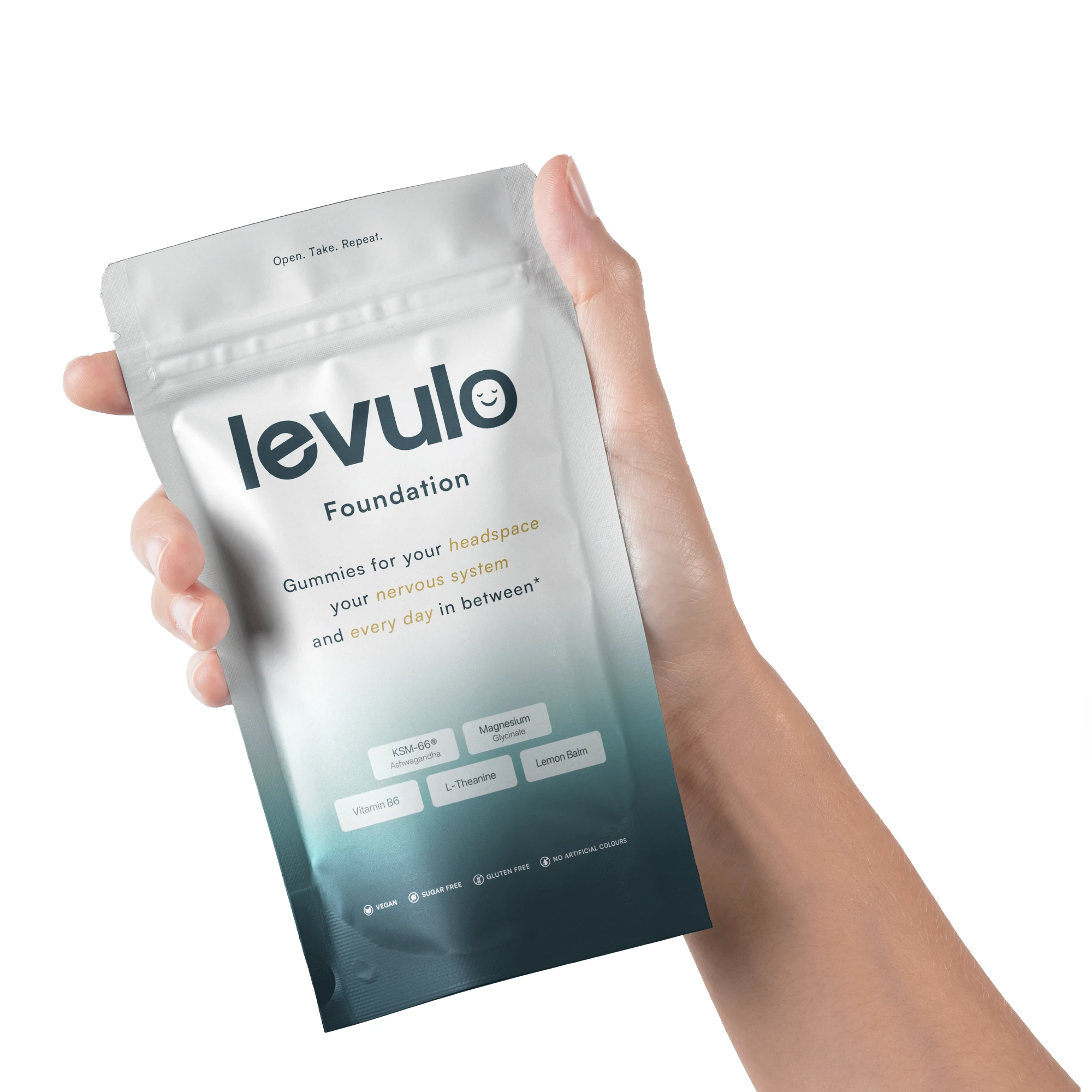
When we built our Daily Foundation Gummies we ended up with five, and we print the amount of each one on the pack, because most of this category doesn't.
KSM-66® Ashwagandha — 500mg. A branded full-spectrum root extract, and the most heavily researched form of ashwagandha available. The root has a long history of traditional use in Ayurvedic practice. 500mg is a real amount; a lot of products use a fraction of that and don't say so.
L-Theanine — 150mg. An amino acid that occurs naturally in green tea leaves. It's one of the more studied non-vitamin ingredients of the last decade and 150mg reflects the amounts used in that research.
Lemon Balm — 100mg. A herb from the mint family that's been drunk as a tea across Europe for centuries. Included at a proper dose rather than as decoration on an ingredients list.
Magnesium Glycinate — 56mg elemental (15% NRV). We state the elemental figure, which is the amount of actual magnesium you get. Plenty of brands quote the compound weight instead, which is a much bigger and much less honest number.
Vitamin B6 — 1.4mg (100% NRV).
Magnesium and Vitamin B6 both contribute to normal psychological function, to the reduction of tiredness and fatigue, and to the normal functioning of the nervous system.*
Ashwagandha, L-Theanine and Lemon Balm are there for the traditional-use and research reasons above. No authorised health claims exist for them in the UK, so we don't make any. If you want the longer version of the reasoning, it's on our science page.
Good habits still come first

I still think the basics come first, obviously. Training, eating properly, getting outside, actually stopping occasionally. All of that matters more than anything you can take.
Nothing in a pouch fixes a week where you've barely moved, eaten rubbish and not switched off once. Anyone telling you different is selling you something.
What a supplement can reasonably do is hold the base steady while you sort out the rest. That's the whole premise of what we built. Not a fix, because realistically there isn't one. Life is busy and demanding and I don't think that's changing any time soon. But if there are ways to support your body better while you're dealing with all that, it makes sense to me.
Most people aren't lazy
I genuinely think a lot of people are just mentally overloaded all the time, and have quietly decided that's their personality now.
It isn't. It's a load. And loads can be put down, or at least made lighter.
If you've got this far and recognised more of yourself than you were expecting, that's probably worth sitting with for a minute before you go back to your inbox.
*Health claims authorised on the GB Nutrition and Health Claims Register. Food supplements should not be used as a substitute for a varied and balanced diet and a healthy lifestyle.
This article describes personal experience and general information. It isn't medical advice. If you're struggling, speak to your GP.
extra tidbits
Things worth knowing
Is burnout the same as being tired?
Why does caffeine stop working when you're mentally overloaded?
How common is burnout in the UK?
What's in Levulo Daily Foundation Gummies?
Journal updates
Once a month we both write something. We're not the best writers, but it's always relevant to health and wellbeing, We promise it's worth subscribing.
Follow our socials:
Why Do We Feel So Burnt Out All the Time?
Louis
•
•
6 Minutes
•
Foundation
I honestly think most people are burnt out right now and don't even realise it properly, because it's become that normal.
Not dramatic burnout. Not the version where you can't function. The low-level one, where you're still hitting your targets and still showing up for everyone, and still feeling a bit flat about all of it.
Mental Health UK's Burnout Report 2026 put the question to 4,502 UK adults. 91% said they'd experienced high or extreme levels of pressure in the past year. That number hasn't shifted in three years running. So if it feels like everyone around you is running close to empty, it's because most of them are.
I thought it was just what being busy felt like
Balancing businesses, training, boxing, being a dad to two kids and trying to somehow keep on top of everything else in life, there was a point where I just thought feeling constantly tired was part of getting older and having responsibilities. You kind of just get on with it.
That's the bit I'd change if I could go back. Not the workload. The assumption that the way it felt was permanent.
Whilst on site one day, 10 feet up a ladder I think it finally hit me, I was truly truly knackered. Not physically though, just feeling off I think? What I hadn't realised at the time is i'd been going none stop for months. My body had adapted to the extra load, but my mind seemingly hadn't. I went home from the job, sat down on the sofa turned the tv on and felt like there was nobody home inside.
It wasn't energy I was short of
For years my answer to feeling flat was just more. More caffeine, more pre-workout, more motivation, more early starts. Tired at three in the afternoon, have another coffee. Training feels heavy, bigger scoop.
None of it held for long, and it took me an embarrassingly long time to work out why.
I wasn't short of energy. I had plenty of energy. What I was short of was any point in the day where my brain wasn't doing something.
That's a different problem. And caffeine doesn't touch it. If anything it makes it worse, because the thing you actually needed was a gap, and you've just filled it.
Burnout isn't quite the same as being tired
Worth knowing what the word means, because it gets used for everything now.
The World Health Organization added burn-out to the ICD-11 in 2019, but not as a medical condition. It sits in the chapter for things that bring people to a doctor without being illnesses. They describe it as an "occupational phenomenon" with three parts: feeling drained, feeling mentally distant or cynical about your job, and feeling like you're not much good at it anymore.
The part I find interesting is that their official definition is much narrower than how any of us actually use the word. The WHO says it applies to work and shouldn't be stretched to other areas of life.
Fair enough as a formal definition. But I don't think it matches what's happening to people. Nobody I know is burnt out purely at work. They're flat at work, and then they go home to a second shift of admin and kids and group chats and life stuff, and the work bit is just the part that happens to have a name.
Ordinary tiredness has an obvious cause and an obvious answer. This doesn't. You can have a genuinely quiet weekend and go back on Monday feeling identical, and that's the bit that makes people assume something's wrong with them.
What being switched on all day actually looks like
You wake up and instantly you're checking your phone. Emails, messages, work problems, social media, people needing things from you. Then you're trying to train, stay healthy, provide for your family, keep everything moving forward and somehow still find time to relax in between all that.
Most people never actually slow down anymore. There's no gap in it.
I noticed it more with myself because even when I was sat still, I still felt switched on. I could be on the sofa at nine at night with the telly on and still be going through things I needed to sort out the next day. Physically stopped, mentally nowhere near it.
If you're trying to work out whether this is you, the signs are pretty boring:
You're getting everything done and none of it feels satisfying
You reach for your phone in any gap longer than about four seconds
You can't sit through a film without a second screen going
Small admin jobs feel weirdly heavy, and you put them off for weeks
You're fine. Genuinely fine. Just permanently running at about seventy percent
That isn't a diagnosis and I'm not qualified to give you one. It's just a fairly reliable sign you're carrying more than you've admitted to yourself.
Why I stopped chasing the buzz
I've tried loads of different things over the years. Mushroom coffees, herbal teas, different supplements, all sorts really.
What I ended up preferring were the ingredients that don't try to make you feel anything straight away. No wired feeling, no rush, no obvious moment where it kicks in. They either do something in the background over a few weeks, or they don't do anything at all, and you judge them accordingly.
That's a much harder thing to sell, obviously. Far easier to sell something you can feel in twenty minutes. But everything I'd tried that I could feel in twenty minutes also wore off inside the hour, and usually left me flatter than I started.
The five things I kept coming back to
When we built our Daily Foundation Gummies we ended up with five, and we print the amount of each one on the pack, because most of this category doesn't.
KSM-66® Ashwagandha — 500mg. A branded full-spectrum root extract, and the most heavily researched form of ashwagandha available. The root has a long history of traditional use in Ayurvedic practice. 500mg is a real amount; a lot of products use a fraction of that and don't say so.
L-Theanine — 150mg. An amino acid that occurs naturally in green tea leaves. It's one of the more studied non-vitamin ingredients of the last decade and 150mg reflects the amounts used in that research.
Lemon Balm — 100mg. A herb from the mint family that's been drunk as a tea across Europe for centuries. Included at a proper dose rather than as decoration on an ingredients list.
Magnesium Glycinate — 56mg elemental (15% NRV). We state the elemental figure, which is the amount of actual magnesium you get. Plenty of brands quote the compound weight instead, which is a much bigger and much less honest number.
Vitamin B6 — 1.4mg (100% NRV).
Magnesium and Vitamin B6 both contribute to normal psychological function, to the reduction of tiredness and fatigue, and to the normal functioning of the nervous system.*
Ashwagandha, L-Theanine and Lemon Balm are there for the traditional-use and research reasons above. No authorised health claims exist for them in the UK, so we don't make any. If you want the longer version of the reasoning, it's on our science page.
Good habits still come first
I still think the basics come first, obviously. Training, eating properly, getting outside, actually stopping occasionally. All of that matters more than anything you can take.
Nothing in a pouch fixes a week where you've barely moved, eaten rubbish and not switched off once. Anyone telling you different is selling you something.
What a supplement can reasonably do is hold the base steady while you sort out the rest. That's the whole premise of what we built. Not a fix, because realistically there isn't one. Life is busy and demanding and I don't think that's changing any time soon. But if there are ways to support your body better while you're dealing with all that, it makes sense to me.
Most people aren't lazy
I genuinely think a lot of people are just mentally overloaded all the time, and have quietly decided that's their personality now.
It isn't. It's a load. And loads can be put down, or at least made lighter.
If you've got this far and recognised more of yourself than you were expecting, that's probably worth sitting with for a minute before you go back to your inbox.
*Health claims authorised on the GB Nutrition and Health Claims Register. Food supplements should not be used as a substitute for a varied and balanced diet and a healthy lifestyle.
This article describes personal experience and general information. It isn't medical advice. If you're struggling, speak to your GP.
extra tidbits
Things worth knowing
Is burnout the same as being tired?
Why does caffeine stop working when you're mentally overloaded?
How common is burnout in the UK?
What's in Levulo Daily Foundation Gummies?
Start today
Build from a stronger base.
Foundation is where it starts. Five actives, two gummies, every dose printed on the pack. £19 for your first month, then £25 — cancel or pause anytime.
Start today
Build from a stronger base.
Foundation is where it starts. Five actives, two gummies, every dose printed on the pack. £19 for your first month, then £25 — cancel or pause anytime.