Foundation
The showdown: Gummies vs Capsules vs Powders

George
9 Minute read

Right, straight out with it. We sell gummies. So you should read everything below knowing that, and I'd rather say it in the first line than bury it at the bottom.
I'm telling you because most of what's written about this is written by someone selling one of the three formats. The articles saying gummies are rubbish tend to be published by capsule brands. The ones saying gummies are the future tend to be published by gummy brands. This one's the second kind, so here's the deal. I'm going to give you the actual case against gummies first, with numbers, including our own.
The only question that really matters
Everything else in this post is detail. The thing that decides it is whether you'll still be taking it in three months.
That's not me being preachy, it's the whole thing. A perfect dose in a format you've abandoned does nothing at all. A merely decent dose you take every day for a year beats it comfortably. So the real questions are pretty boring ones.
Will you keep taking it if it tastes like a multivitamin smells. Can you actually swallow capsules, and I mean without thinking about it. Does your powder mix properly or does it sit in a lump at the bottom of the glass.
Answer those honestly and you've mostly answered the question. But there's a load of stuff underneath that nobody explains properly, so let's get into it.
Capsules hold more than anything else, and that's not the whole story
If you can take capsules, take capsules. I'll do the case for gummies further down, but I'm not going to pretend this bit away.
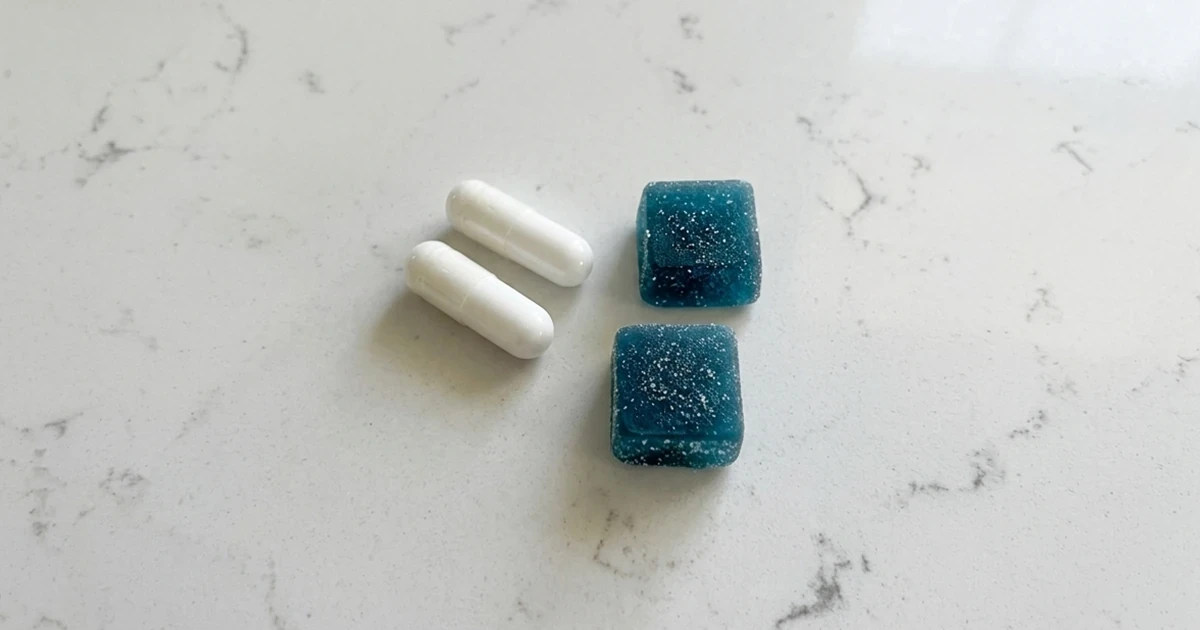
Capsules hold more. A capsule is basically an empty shell you fill with powder, so almost all of the weight is the thing you're paying for. You can get 500 to 800mg of active into one without much trouble, and you can take two or three of them.
They're more stable. Dry powder in a sealed shell is about the most boring environment you can put an ingredient in, and boring is exactly what you want. Nothing much happens in there for two or three years.
They're cheaper per milligram, by a distance. You're not paying for pectin, flavour, sweetener or the machinery that turns all that into a chewy thing.
And the dose is the dose. Same amount in every capsule, start of the tub to the end.
So what's wrong with them
Two things, and the second is the reason we're not in this business.
You need water. Which sounds trivial until you count the number of times in a day you've got a capsule in your hand and nothing to wash it down with. It makes a capsule a two-item product, and two-item products get skipped.
And a lot of people simply hate swallowing them. Not can't, in the medical sense. Hate it. Up to 40% of people report difficulty with solid dose forms, most of them with no diagnosed swallowing condition at all, and of those who struggle a meaningful number delay doses, skip them or stop taking things entirely. Almost none of them tell anyone that's why.
That's the gap gummies exist in. Not absorption, not bioavailability, nothing clever.
Powders are the right answer for some things and overkill for most
Powders win on the one thing capsules can't touch, which is scale.
Some ingredients need grams, not milligrams. Creatine is five grams a day. Electrolytes, protein, collagen, all measured in grams. You physically cannot capsule that without handing someone a bottle and telling them to take eleven, so powder isn't a preference there, it's the only sensible answer. It's also the cheapest format per gram by a long way.
The problem is everything around actually taking it. You need a scoop, a glass, a liquid, usually a shaker, and thirty seconds you don't always have. And most of them taste like something you'd wash a car with, which people underestimate right up until day nine.
If what you need adds up to about a gram in total, powder is a lot of faff for no benefit. If what you need is five grams of creatine, nothing else works.
The case against gummies, which is real
Here's the bit most gummy brands skip.
The dose ceiling
A gummy isn't a container, it's a matrix. You're not filling an empty shell, you're dissolving actives into pectin and water and flavour and sweetener and then setting the whole lot. There's a hard limit on how much you can load in before the texture collapses or it tastes genuinely horrible, and it's not a generous limit.
That's why you'll almost never see a decent iron or calcium gummy at a proper dose. It isn't laziness. The maths doesn't work.
It's also the reason a magnesium sleep gummy is far harder to build than it sounds. The one randomised trial on magnesium bisglycinate and sleep, 155 adults published last year, used 250mg of elemental magnesium a day. Getting 250mg of elemental magnesium out of bisglycinate takes roughly 1,790mg of the compound. That's more than everything currently in two of our gummies, for a single ingredient.
Worth saying the evidence there is thin anyway. The most recent systematic review of the randomised trials, published this August, found the results mixed. The figure that gets quoted everywhere, seventeen minutes faster to fall asleep, comes from a pooled analysis of three trials in 151 older adults whose own authors concluded the literature was substandard for making recommendations. Every brand citing that number is citing something the people who calculated it disowned in the same paper.
So if you see a magnesium sleep gummy, it's either nowhere near the dose used in the research, or it isn't telling you what's in it. Possibly both.
Stability, and the thing nobody mentions
Gummies hold moisture, and moisture is where degradation happens. It's enough of a known problem that USP sets wider tolerance ranges for gummies than it does for tablets. That's not a brand's opinion, it's how the standard is written.
Which leads to the part nobody explains. Because gummies lose potency faster, manufacturers build in overage, meaning they put in more than the label says so the label still holds at the end of shelf life. That's normal, it's legitimate, and it's the right way to do it. It also means the amount in a gummy on day one and the amount on day four hundred are not the same number.
They look like sweets
Which is the entire reason they work, and also the reason people eat four. With most of what we use that's a non-issue. With fat-soluble vitamins and minerals that have upper limits it isn't, and it's a fair criticism of the category.
And no, they don't absorb better
You should be suspicious of anyone who tells you otherwise without qualifying it.
For water-soluble vitamins at an equivalent dose, absorption between formats is broadly comparable. The chewing-means-it-starts-digesting-sooner line is technically true and largely irrelevant, because for most actives you're talking about a difference that doesn't show up in your blood.
There's one interesting exception. A crossover study in healthy adults found vitamin D3 gummies produced roughly double the blood concentration of tablets over time. That's probably the oil content of the gummy rather than the format itself, and it's specific to vitamin D. Useful finding, doesn't generalise, which is exactly why you see it cited in places it shouldn't be.
We don't make an absorption argument for the format, because we can't support one.
So why is our magnesium only 15%?
Firstly, large magnesium doses are typically reserved for relaxation or sleep formulas amongst other companies. Foundation wasn't formulated to do that. However it does offer benefits in the way of nervous system support, normal pshcological funcation and reduction of tiredness and fatigue.
So it earns it's place in Foundation, just not in a large quantity.
There's 56mg of elemental magnesium in two of our gummies, which is 15% of the daily reference value. That's a real number and it's on the pack, but it is not a big number and I'm not going to dress it up.
Here's why it is what it is. To get 56mg of elemental magnesium out of magnesium glycinate you need roughly 400mg of the compound, because the magnesium is only about 14% of it by weight. Stack that with 500mg of KSM-66, 150mg of L-theanine, 100mg of lemon balm and the B6, and you're carrying something like 1,150mg of actives across two gummies. That's already pushing what the format takes.
Now say we wanted 100% NRV magnesium instead. That's 375mg elemental, which needs somewhere around 2,680mg of glycinate. For one ingredient. More than double everything that's currently in there, before you've added anything else back.
So which should you actually buy
If maximum magnesium is what you're after, buy magnesium capsules. Genuinely. You'll get more for less money and I'd rather tell you that than sell you something that doesn't do what you wanted.
But everything above is why capsules look better on a spreadsheet, and a spreadsheet isn't where any of this actually happens.
The whole argument for gummies is the 40% from earlier. A lot of people don't reliably take capsules and mostly won't tell you that's why they stopped. Add the water thing on top, and you've got a format that removes the two most common reasons people quit.
Ours are sugar-free as well, which deals with the most common and most deserved criticism of the category.
So:
If you take capsules without thinking about it, take capsules. More in them, cheaper, more stable. Not a hard call.
If you need grams of something, powder, and don't overthink it.
If you've got a drawer with three half-finished tubs in it, that's your answer, and it's the answer for more people than the spreadsheet suggests.
We went with gummies because reliability was the thing we cared about most, and because the doses we wanted fit, just about. Magnesium and Vitamin B6 both contribute to normal psychological function and to the reduction of tiredness and fatigue.*
Don't buy a format because a brand told you it was best. Buy the one you'll still be taking at the end of the year.
*Health claims authorised on the GB Nutrition and Health Claims Register. Food supplements should not be used as a substitute for a varied and balanced diet and a healthy lifestyle.
George
Is a co-founder of Levulo. He has a drawer with three half-finished tubs of capsules in it, which is largely how we ended up here.
FAQs
More thoughts